How To: Block coloring, learn the foundations of art
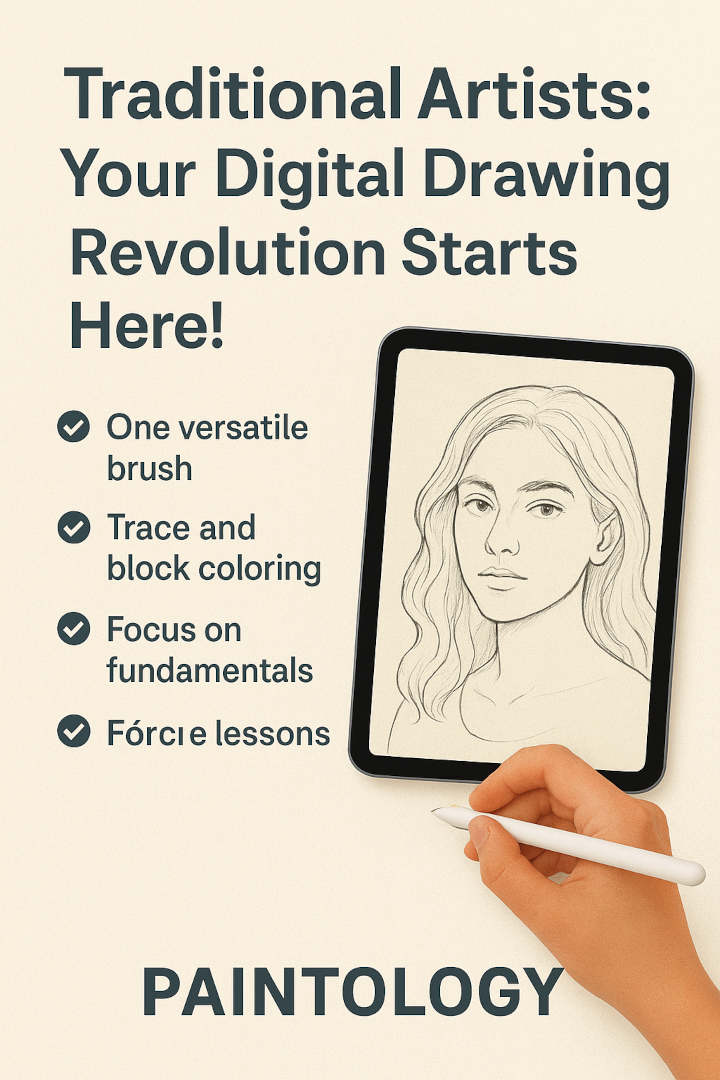
Paintology Block Coloring: Your Guide to Learning the Foundations of Art
Philosophy: Less Tools, More Foundation. This method bypasses the complexity of color theory and tool selection to train the most critical artistic skills: observation, hand-eye coordination, and brushwork.
Core Concept: You are not "coloring." You are reconstructing an image by manually matching its colors and values with your own strokes, one block at a time.
The Four-Step Learning Framework
Follow these steps to build your skills progressively.
Step 1: Setup for Success
- Choose the Right Image: Start simple!
- Beginners: Choose images with large, clear areas of color (e.g., a simple fruit, a mug, a cartoon character).
- Avoid: Photos with complex details like faces, hair, or busy landscapes for your first attempts.
- Enter Trace Mode: Load your chosen image into the Paintology app and activate "Trace" or "Reference Image" mode. The image will be visible on your canvas as a guide.
- Select a Simple Brush: Use a basic round brush with medium hardness. Avoid special effect brushes. The goal is to master the fundamental stroke.
Step 2: The Core Technique - Observe, Sample, Stroke
This is the fundamental loop. Practice it until it becomes natural.
- OBSERVE (The Most Important Step):
- Look at a small section of the reference image. Don't see "an apple"; see a shape of a specific color. Is it a roundish red shape? A smaller, darker red shape next to it?
- Identify the boundaries of this "block" of color.
- SAMPLE:
- Place your finger or stylus directly onto the screen over the center of the color block you are observing.
- The app will automatically pick up the exact underlying color. You are now "holding" that color.
- STROKE:
- Lift your tool and move to where you want to paint. Now, apply the color using confident, deliberate strokes.
- Focus on the Shape: Try to mimic the shape of the color block you observed. Use multiple strokes to build it up.
- Don't Worry About Perfection: The goal is not a perfect fill. The goal is to place a patch of the correct color in the correct location. The character of your hand-drawn strokes is what makes the result unique.
- REPEAT: Lift your tool, find the next adjacent block of color, and repeat the process: Observe -> Sample -> Stroke.
Step 3: Skill-Building Exercises
Practice these specific drills to improve different foundational skills.
- Exercise 1: Big Shapes First. Focus only on the largest areas of color. Ignore all details. Can you capture the light, mid-tone, and shadow areas of a simple object? This teaches you to see the "big picture" – a vital skill for all artists.
- Exercise 2: Value Matching (Grayscale). Try the method with a black-and-white photo. This trains you to see values (how light or dark something is) without the distraction of color. Accurate values are more important than accurate color for creating a believable image.
- Exercise 3: Stroke Direction. Consciously change your stroke direction to follow the form of the object. For a sphere, use curved strokes. For a cube, use straight strokes. This adds volume and texture to your work.
Step 4: Progressing to Mastery
As you become comfortable, increase the challenge:
- Decrease Block Size: Start breaking larger areas into smaller, more precise blocks. This is how you add detail.
- Tackle Complex Subjects: Move on to portraits, landscapes, and intricate objects. You'll learn to see a face not as eyes and a mouth, but as an intricate mosaic of colored shapes.
- Analyze Your Results: Compare your finished block-colored drawing to the original. Where are the colors or values off? This analysis is powerful feedback for your observational skills.
Troubleshooting & Pro Tips
- Problem: "My drawing looks messy and blotchy."
- Solution: You might be moving too fast. Focus on making deliberate, purposeful strokes. It's better to have 10 clean strokes that define a shape than 50 messy ones.
- Problem: "The colors don't look right together."
- Solution: Trust the process! The color is sampled directly from the master image. If it looks wrong, it's often because the value (lightness/darkness) of the surrounding blocks isn't correct yet. Complete more of the image before judging.
- Pro Tip: Zoom In. Use the zoom function for detailed areas. This allows for greater precision when sampling and applying color in small sections.
- Pro Tip: Embrace Imperfection. The slight mismatch between your hand-drawn blocks and the original is what gives the artwork its charm and proves it was made by a human hand, not a filter.
The Ultimate Goal: Transferable Skills
The true benefit of this method is that these skills directly transfer to traditional drawing and painting. You are training your brain to:
- Deconstruct complex scenes into simple shapes.
- Match color and value accurately.
- Apply paint with intention.
By mastering Block Coloring in Paintology, you are not just creating digital images; you are building a rock-solid foundation for all your future artistic endeavors.